The project at a glance
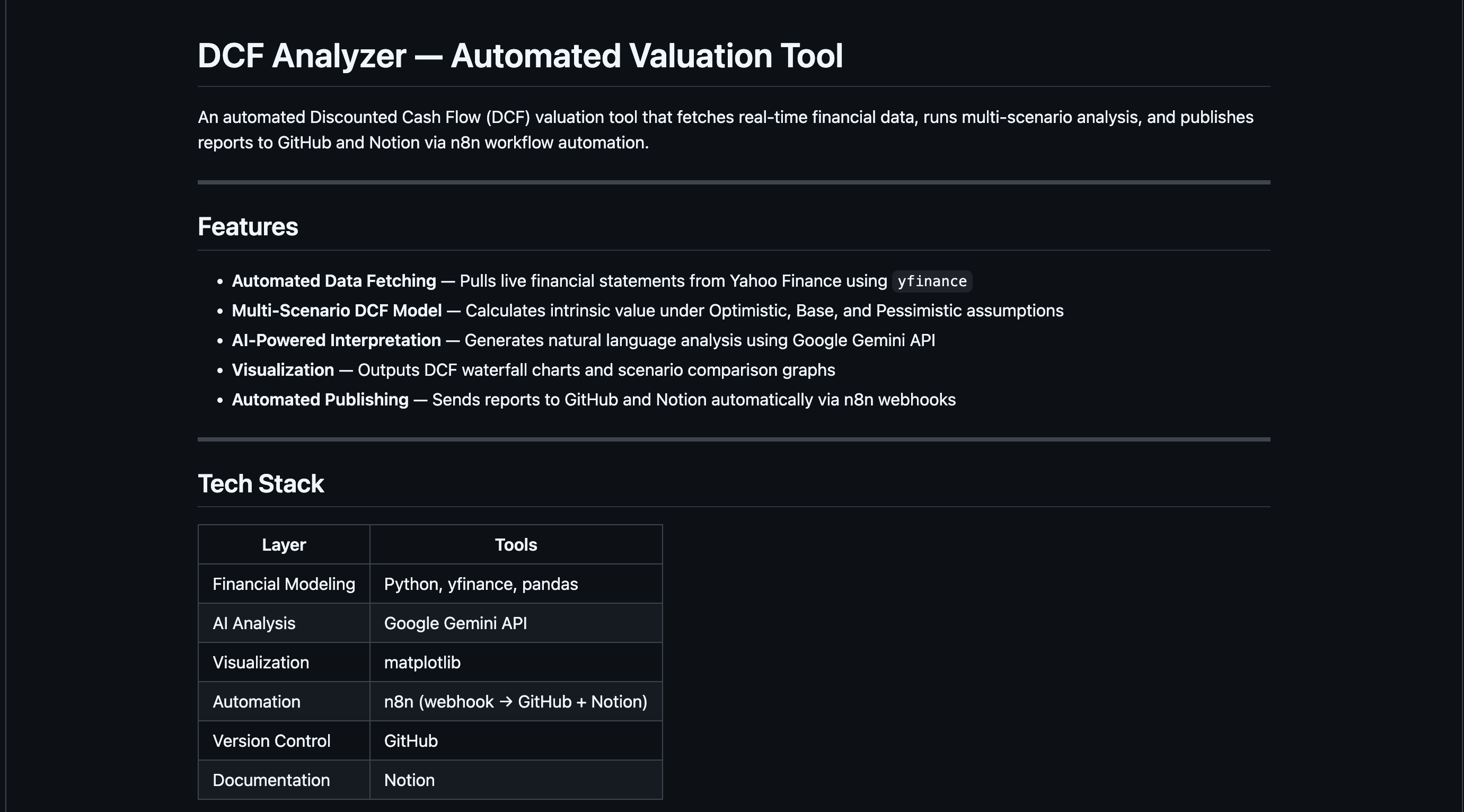
Original project overview. Open to read at full size. The saved example below is historical.
The problem & my role
I built a Python valuation workflow to make recurring financial-data collection, scenario calculations, and report preparation repeatable. n8n connects the analysis to reporting destinations, while Gemini produces an interpretation for review.
Python handles the financial calculations and data; n8n coordinates the workflow. AI-written interpretation is a separate layer, not a substitute for validating the model.
A historical output, with its assumptions attached.
This example is dated 1 March 2026. The saved report lists a market price of $392.74 and base free cash flow of $71.61bn from Yahoo Finance via yfinance. These values are historical report inputs, not a current market feed.
| Scenario | Model estimate | Vs. saved price |
|---|---|---|
| Optimistic | $232.43 | −40.8% |
| Base | $190.12 | −51.6% |
| Pessimistic | $154.48 | −60.7% |
Five-year projection; growth assumptions of 15%, 10%, and 5%; a 10% discount-rate proxy; and 3% terminal growth. These are scenario inputs, not verified market consensus or a calculated WACC.
My interpretation
A 51.6% gap between DCF value and market price says more about the model than about Microsoft. A flat 10% discount rate treats Azure and Copilot revenue the same as the legacy license business, and a 5-year window cuts off right as AI monetization is meant to scale — so the model may be discounting the wrong things at the wrong rate rather than the market being wrong. Before trusting the "overvalued" conclusion, I'd rebuild this with a two-stage growth model and a bottom-up WACC calculation. Right now this is more useful for spotting which assumptions the market disagrees with than for calling the stock over- or under-priced.
Preserved from the existing portfolio. Interpretation of the model, not a verified explanation of market pricing.
Read the archived AI interpretation
Our Discounted Cash Flow (DCF) analysis indicates that Microsoft's current market price of $392.74 may be significantly overvalued based on fundamental cash flow projections. The base case scenario, utilizing a 10% free cash flow growth rate, yields an intrinsic value of $190.12, representing a 51.6% downside from the current price. Even under an optimistic scenario with a 15% annual growth rate for the next five years, the valuation reaches only $232.43, still 40.8% below the market price.
The primary driver for this discrepancy appears to be the market embedding a substantial premium for factors not fully captured by a conventional five-year DCF — the transformative potential of generative AI across Microsoft's product suite, sustained hyper-growth in Azure, and potential long-term margin expansion. The market is effectively pricing in a much longer high-growth period and a lower risk profile than this model assumes.
For the market price to be justified, Microsoft must not only meet but dramatically outperform even the optimistic growth projections for an extended period. The valuation is heavily reliant on successful, widespread, highly profitable monetization of its AI initiatives — any stumble in execution or shift in the competitive landscape could trigger a significant repricing.
Validation & limits
The scenario percentages reconcile, to rounding, to the saved price and model outputs. The underlying data retrieval and full valuation calculation have not been rerun for this website.
A five-year model and flat discount rate simplify the business substantially. Input provenance, a bottom-up WACC, the equity bridge, terminal-value sensitivity, and multi-stage growth are important checks before interpreting an investment conclusion.
The workflow is documented as local n8n work. Its current execution status is not verified here. No live demo is implied.
Business relevance & learning
Repeatable calculations make assumptions easier to compare. The output is most useful as a starting point for questions: which growth path, discount rate, or terminal value would change the conclusion?
Separating deterministic calculations from AI prose makes the analytical responsibility clearer. A well-written explanation can still be unsupported.
Educational portfolio work. Not investment advice.
Explore the Python source